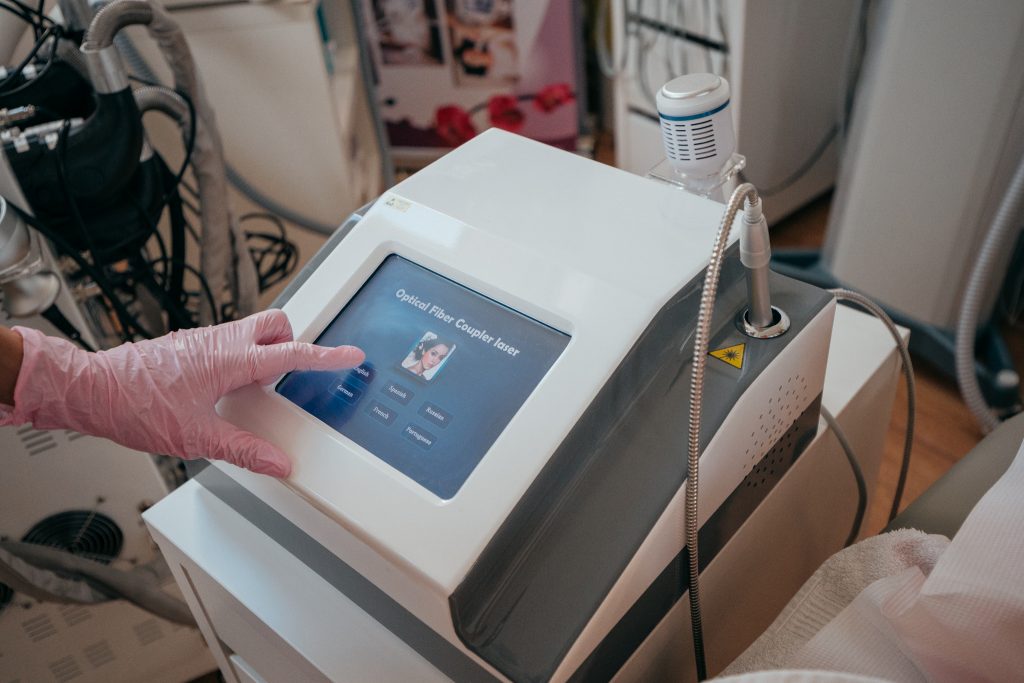
The Diode Laser uses a wavelength of 980nm with immediate effect and long-lasting results. The laser emits a large amount of concentrated heat on the target vein and destroys it.
Advantages over similar treatments
- Results are immediate
- Can be applied for capillaries thinner than 3 mm
- Can be used even in hard-to-reach areas (legs, knees, nose, etc.)
- Can be applied on any skin type
- Does not necessarily require the use of special (compression) stockings, but if there are serious venous problems, we still recommend them.
The system delivers short laser pulses that cause coagulation of the blood inside the vessel, eventually destroying the vessel which will subsequently be reabsorbed by the body. Blood flow is thus redirected to the deep veins.
We advise you to avoid sun exposure for at least 2 weeks after treatment and to avoid predisposing or aggravating factors that may lead to recurrence.
How many treatments are needed?
3-4 treatments per area are sufficient, with 3-4 weeks between sessions. However, the number of treatments needed depends on the number, color and size of the vessels to be treated.
Results vary individually. There are situations when a Doppler ultrasound of the lower limbs is recommended before laser treatment. People with a genetic predisposition to this condition may require adjuvant treatment recommended by a cardiologist.
Is the treatment painful?
Most people experience a stinging sensation upon laser pulse impact. The laser's high-performance cooling system provides sufficient anesthesia for the treatment to be comfortable. After treatment, pain is minimal or non-existent.
Side effects
The most common are slight redness of the area and swelling. These symptoms last less than 24 hours. In rare cases, bruising or minor burns may occur.
When are results visible?
A significant improvement in appearance is observed after the second or third session. However, the final result may not be visible for several months.
Price
3 pulses/1 RON. Pulses differ depending on the area; for a small area of 10/10 square cm, an average of 500-1000 pulses are needed.